Infant Suck Strength Exam: Introduction of an Accessible Clinical Technique for Measuring Infant Suck at the Breast
Article Reference:
Chetwynd E. Infant Suck Strength Exam: Introduction of an Accessible Clinical Technique for Measuring Infant Suck at the Breast. Journal of Human Lactation. 2024;40(3):414-418. doi:10.1177/08903344241257227
Background
A core skill required in lactation support is understanding and correcting ineffective or painful breastfeeding. Lactation support providers (LSPs) might assess the function of the infant’s sucking skills during nursing by test weighing; listening for audible swallows with or without cervical auscultation; and observing latch, positioning, movement of the infant's jaw, the post-feed maternal nipple, and maternal and infant behavior/feedback (Lawrence & Lawrence, 2021). Many LSPs will also use a digital exam with a gloved finger to qualitatively assess infant suck strength (Watson Genna, 2016), the motor that drives the lactation feedback mechanism and transfer of milk. These assessment techniques, however, are limited by our inability to see inside the infant’s mouth during breastfeeding and, in the case of a digital exam, inability to replicate an infant’s behavior at breast.
To facilitate reliable, objective assessments, validated instruments have attempted to standardize assessments of infant function at the breast (Agarwal et al., 2024; Jensen et al., 1994; Matthews, 1988; Mulford, 1992) using infant’s latch (deep or shallow, clicking, chewing or clamping), the condition of the nipple (damage, blanching, post-feed shape), the infant’s behavior during feeding (coughing, choking, gagging, tongue clicking, frustration, lip tucking, coming on and off the nipple during feeding) and after feeding (fussy, sleepy, arching, gassy), and the parent’s pain during nursing. Similarly, devices have been developed to gauge infant suck strength, including pressure sensitive pacifiers or bottles and mechanical devices on the breast (Truong et al., 2022). Geddes et al. (2008) used a supply line with milk and a pressure transducer in conjunction with ultrasound to assess the strength of the infant suck as well as tongue movement. These instruments and devices attempt to piece together what is happening inside the baby’s mouth during breastfeeding; however, the instruments cannot measure suck strength and devices that measure suck strength have not been integrated into mainstream clinical lactation support.
In this article, I describe a technique from my clinical practice that employs a simple method for evaluating the strength of the infant’s suck during direct breastfeeding without the use of any device. The technique can also help guide the LSP in advising parents on potentially corrective measures to overcome precise areas of infant suck weakness.
Clinical Presentation / Evaluation
Many infant breastfeeding skills are instinctual. The suckling or suckling reflex causes the infant to draw the nipple from the front of the mouth to the back. It helps the tongue draw in milk by sealing and unsealing the back third of the tongue (Bahr, 2010). However, as with all humans, infants will sometimes take short cuts or will compensate for physical shortcomings. As a result, pain or poor milk transfer may occur.
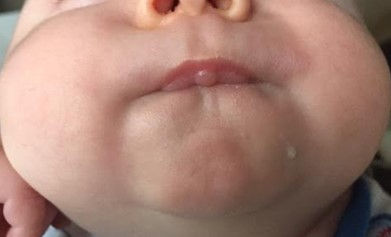
For example, sometimes the infant’s lower lip will curl in towards the breast, moving in and out to create a draw at the breast. This appears like a shoveling motion and will cause muscle build-up in the lower lip (Figure 1). Since the lower lip is moving, it is no longer performing its primary role, which is to stabilize the breast (Kozlovsky, et al., 2014). This non-standard movement of the lower lip on the breast can abrade the underside of the nipple/areola. To maximize the effectiveness of this inefficient sucking technique, the infant will tip their head back, so that the lower lip has more access to the underside of the breast. This, in turn, can encourage the tongue tip to drop back in the infant’s mouth and the upper lip to work harder to stabilize the nipple. In this situation, the baby might appear to be deeply-latched—well tucked into the breast, with the neck extended (which is taught as a useful position in asymmetric latch) (Wilson-Clay & Hoover, 2008). If the parent has an overactive letdown or abundant milk supply, the weighted feed might even indicate good milk transfer, but parental pain would persist.
Clinical Intervention: Infant Suck Strength Exam at the Breast (ISSE)
The Infant Suck Strength Exam (ISSE) is applied during active nursing to localize any weakness in infant suck. Once the infant is well engaged on the breast, the LSP pulls back on the breast in 4 quadrants, two corresponding to the corners of the mouth, one to the lower lip, and one to the upper lip. Fingers are placed on the skin of the breast, without creating an indention in the breast, about 2-4 cm away from the infant’s lip. The skin of the breast is gently pulled back toward the chest wall (Figure 2). The breast either stays in the infant’s mouth or the nipple slips out (Video 1). There is almost never pain with the exam, and sometimes when the skin is pulled taut during this exam, it actually reduces or eliminates the pain. The areas that slip when the breast is pulled back indicate localized areas of weakness in the infant’s suck.

This technique takes advantage of the suck reflex. When the infant is already sucking, and the breast is pulled back, they must re-engage the suck reflex to draw the nipple back into their mouth. We all have this urge – imagine if you had a popsicle in your mouth and someone pulled on it – if you wanted to keep it in your mouth, you could suck harder, drawing it into the back of your mouth. While this would be a controlled action in an adult, until about 6-12 months, it is a reflexive action in the infant (Bahr, 2010). Weakness is uncovered using this test similarly to the way a physical therapist might uncover weakness in an arm by pulling against a resistive hold. Video 2a and 2b illustrate the ISSE being used with an infant before and after a frenotomy. The exam shows the immediate difference in the infant’s oral strength post-procedure (video 2a, 2b).
In the example of the infant overusing their lower lip, the ISSE would almost certainly uncover weakness near the infant’s lower lip, since that lip is being used as part of the sucking mechanism rather than for stabilizing the breast. There might also be weakness near the upper lip, since that lip would not be working in tandem with the lower lip to stabilize the breast, resulting in a suction action with the upper lip as well. In this case, the LSP might observe a ‘chomping’ or ‘biting’ suck style or a visible suck blister on the infant's upper lip. When the nipple slips out of the infant’s mouth when ISSE is applied at the corner of the mouth, cranial asymmetry might be the cause of the weakness. Sometimes the suck is weak overall, with no specific areas of strength.
Application of Traction to Address Weakness
The ISSE can also be used to correct areas of suck weakness. In the case of the lower lip ‘shovel,’ the LSP would work to disengage the overuse of the lower lip and could do so by lifting the breast off of the chin and gently providing traction at the lower breast toward the chest wall. Not only does this draw the lower lip out into a flanged position while using skin traction to hold it in place, but it would also physically drag the tongue forward into a more ideal position for effective sucking. Weakness or ‘biting’ at the top of the breast can be disengaged by gently pulling back at the top of the breast, using just the skin and not indenting the breast. For infants with a markedly weak suck, pulling back at the corner of the mouth is the least disruptive while still creating enough traction to draw out the suck reflex. Typically, if there is pain, this gentle engagement of the suck reflex will decrease or eliminate the pain immediately. For parents with poor milk transfer, they will often note the sensation of a stronger draw at the breast. ISSE traction needs to be applied as consistently as possible throughout the feeding for about a week or two to reorient the infant’s approach to the breast. It is important to remind parents they will only need to use the technique until the infant can do the work on their own.
Of note, applying the ISSE assessment/traction techniques to the breast can feel or look like a shallower latch. However, the ISSE occurs after the latch has been secured. Working exclusively toward a deep latch can assist some infants toward correct tongue posture and use, but for others, it can conceal more complex oral dysfunction. If the LSP corrects a latch without correcting the oral dysfunction leading to the poor latch, the infant is likely to slip back into habitual behavior. ISSE is meant to uncover and address oral dysfunction occuring with or without external appearance of a poor latch.
While ISSE is a technique that I teach and apply in my own clinical practice with success, it has not been formally studied. Rather than taking the place of existing assessment skills, it is meant to build on what an LSP might already employ to assess and treat nipple pain and poor milk transfer.
Summary: Application to the Field of Lactation Support
Classic lactation support techniques to address nipple pain and poor milk transfer mostly focus on latch assessment and correction; they are less able to identify and modify potential oral dysfunction occurring inside the infant’s mouth. The ISSE utilizes the suck reflex to uncover and treat specific areas of weakness and is easy for LSPs to apply in any breastfeeding support setting.
References
Agarwal, R., Eddis-Finbow, M., Tam, J., Broatch, J., & Bussey, K. J. (2024). New Validated Tool to Diagnose Breastfeeding Dysfunction. Journal of Human Lactation, 40(1), 120-131. https://doi.org/10.1177/08903344231209306
Bahr, D. (2010). Nobody ever told me (or my mother) that!: Everything from bottles and breathing to healthy speech development. Sensory World. ISBN 13:978-1-935567-20-2
Wilson-Clay, B., Hoover, K. (2008). The Breastfeeding Atlas, Fourth Edition. BWK/KH Joint Venture. ISBN 0-9672758-5-7
Geddes, D.T.; Kent, J.C.; Mitoulas, L.R.; Hartmann, P.E. (2008). Tongue movement and intra-oral vacuum in breastfeeding infants. Early Human Development, 84, 471–477. https://doi.org/10.1016/j.earlhumdev.2007.12.008
Geddes, D. T., Gridneva, Z., Perrella, S. L., Mitoulas, L. R., Kent, J. C., Stinson, L. F., ... & Hartmann, P. E. (2021). 25 years of research in human lactation: from discovery to translation. Nutrients, 13(9), 3071. https://doi.org/0.3390/nu13093071
Jensen, D., Wallace, S., & Kelsay, P. (1994). LATCH: A breastfeeding charting system and documentation tool. Journal of Obstetric, Gynecologic, & Neonatal Nursing, 23(1), 27–32. https://doi.org/10.1111/j.1552-6909.1994.tb01847.x
Elad, D., Kozlovsky, P., Blum, O., Laine, A. F., Po, M. J., Botzer, E., Dollberg, S., Zelicovich, M., & Ben Sira, L. (2014). Biomechanics of milk extraction during breast-feeding. Proceedings of the National Academy of Sciences of the United States of America, 111(14), 5230–5235. https://doi.org/10.1073/pnas.1319798111
Lawrence, R. A., & Lawrence, R. M. (2021). Breastfeeding: a guide for the medical professional. Elsevier Health Sciences. ISBN: 9780323680134
Matthews, M. K. (1988). Developing an instrument to assess infant breastfeeding behaviour in the early neonatal period. Midwifery, 4(4), 154–165. https://doi.org/10.1016/S02666138(88)80071-8
Mulford, C. (1992). The Mother-Baby Assessment (MBA): An “Apgar Score” for breastfeeding. Journal of Human Lactation, 8(2), 79–82. https://doi.org/10.1177/089033449200800216
Truong P, Walsh E, Scott VP, Coleman T, Tilvawala G, Friend J. Non-Nutritive Suckling System for Real-Time Characterization of Intraoral Vacuum Profile in Full Term Neonates. IEEE J Transl Eng Health Med. 2022 Dec 23;11:107-115. doi: 10.1109/JTEHM.2022.3231788. PMID: 36619906; PMCID: PMC9815562.
Watson Genna, C. (2016). Supporting sucking skills in breastfeeding infants. Jones & Bartlett Learning. ISBN 10: 1284093913


